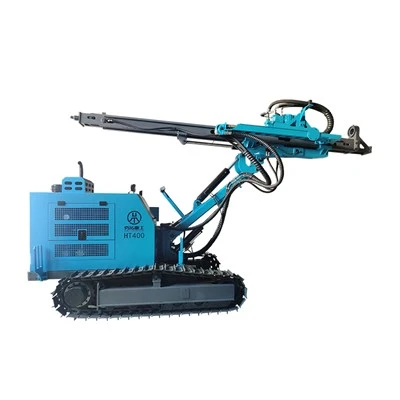
As a seasoned supplier of crawler mounted drill rigs, I've had the privilege of witnessing firsthand the evolution and complexity of these remarkable machines. In this blog, I'll delve into the intricacies of the control system of a crawler mounted drill rig, shedding light on its components, functions, and the technological advancements that have shaped its development.
The Basics of a Crawler Mounted Drill Rig
Before we dive into the control system, let's briefly understand what a crawler mounted drill rig is. These rigs are heavy - duty machines designed for various drilling applications, such as mining exploration, geotechnical investigations, and water well drilling. The crawler tracks provide excellent mobility and stability on rough terrains, allowing the rig to access remote and challenging locations.
Components of the Control System
1. Operator Console
The operator console is the nerve center of the crawler mounted drill rig. It is equipped with a variety of controls, displays, and indicators that allow the operator to monitor and manipulate the rig's functions. Modern consoles often feature touch - screen displays, which provide a user - friendly interface for accessing different operating modes, adjusting drilling parameters, and viewing real - time data.
The console typically includes controls for the crawler movement, such as forward, reverse, and steering. It also has controls for the drill mast, including raising, lowering, and tilting. Additionally, there are controls for the drilling process itself, such as the rotation speed of the drill bit, the feed rate, and the application of pressure.
2. Sensors
Sensors play a crucial role in the control system of a crawler mounted drill rig. They are responsible for collecting data about various aspects of the rig's operation and environment. For example, inclinometers are used to measure the angle of the drill mast, ensuring that it is properly aligned for accurate drilling. Pressure sensors are installed in the hydraulic system to monitor the pressure levels, which is essential for the safe and efficient operation of the rig.
Load sensors can be used to measure the weight on the drill string, providing valuable information about the drilling resistance. Temperature sensors are also important, as they can detect overheating in critical components such as the engine or hydraulic pumps, allowing for timely maintenance and preventing damage.
3. Hydraulic Control System
The hydraulic system is the muscle of the crawler mounted drill rig, and its control is a vital part of the overall control system. Hydraulic valves are used to direct the flow of hydraulic fluid to different actuators, such as cylinders and motors. These valves can be controlled manually from the operator console or automatically based on the input from sensors.
The hydraulic control system allows for precise control of the rig's movements. For example, the extension and retraction of the drill mast cylinders can be carefully regulated to ensure smooth and accurate positioning. The rotation of the drill bit is also controlled by hydraulic motors, and the speed and torque can be adjusted according to the drilling requirements.
4. Electronic Control Unit (ECU)
The Electronic Control Unit is the brain of the control system. It receives data from the sensors, processes it, and sends commands to the various actuators and components of the rig. The ECU uses pre - programmed algorithms to optimize the drilling process and ensure the safety and efficiency of the rig.
For instance, if the load sensor detects an excessive drilling resistance, the ECU can automatically adjust the rotation speed and feed rate of the drill bit to prevent stalling or damage. It can also monitor the hydraulic pressure and temperature, and if abnormal values are detected, it can trigger alarms and take corrective actions, such as reducing the power output or shutting down the system.
Functions of the Control System
1. Drilling Parameter Control
One of the primary functions of the control system is to control the drilling parameters. These parameters include the rotation speed of the drill bit, the feed rate, and the applied pressure. The optimal values of these parameters depend on various factors, such as the type of rock or soil being drilled, the diameter of the drill bit, and the depth of the well.
The control system allows the operator to set these parameters accurately, and it can also adjust them automatically during the drilling process. For example, as the drill bit penetrates deeper into the ground, the resistance may increase, and the control system can increase the pressure and adjust the rotation speed accordingly.
2. Safety Functions
Safety is of utmost importance in the operation of a crawler mounted drill rig. The control system is equipped with several safety functions to protect the operator, the rig, and the surrounding environment.
Emergency stop buttons are provided on the operator console and at other strategic locations on the rig. When pressed, these buttons immediately shut down all the critical functions of the rig, preventing any further movement or operation. The control system also monitors the hydraulic pressure, temperature, and other vital parameters, and if any of these values exceed the safe limits, it can trigger alarms and shut down the system to prevent damage.
3. Automation and Remote Operation
With the advancement of technology, modern crawler mounted drill rigs are increasingly incorporating automation and remote operation capabilities. The control system can be programmed to perform repetitive tasks automatically, such as drilling a series of holes at predetermined intervals and depths.
Remote operation allows the operator to control the rig from a safe distance using a wireless communication device. This is particularly useful in hazardous or hard - to - reach locations. The operator can monitor the rig's status and control its functions in real - time, ensuring efficient and safe operation.
Technological Advancements in the Control System
1. Integration of IoT (Internet of Things)
The integration of IoT technology has revolutionized the control system of crawler mounted drill rigs. IoT sensors can be installed on the rig to collect a vast amount of data, which can be transmitted to a cloud - based platform for analysis. This data can include information about the rig's performance, maintenance requirements, and environmental conditions.
By analyzing this data, operators can gain valuable insights into the rig's operation, predict potential failures, and optimize the drilling process. For example, predictive maintenance can be performed based on the data collected from the sensors, reducing downtime and maintenance costs.
2. Advanced Software and Algorithms
The development of advanced software and algorithms has also improved the performance of the control system. These algorithms can optimize the drilling process by considering multiple factors simultaneously, such as the geological conditions, the drill bit wear, and the energy consumption.
For example, some algorithms can adjust the drilling parameters in real - time to maximize the penetration rate while minimizing the energy consumption. They can also take into account the drill bit wear and automatically adjust the drilling process to extend the life of the bit.
Related Products
If you are interested in other types of drilling rigs, we also offer small water well drilling rig, truck mounted water well drilling rig, and groundwater drilling rig. These rigs are designed to meet different drilling needs and offer high - performance and reliability.
Conclusion
The control system of a crawler mounted drill rig is a complex and sophisticated system that plays a crucial role in the safe, efficient, and accurate operation of the rig. With the continuous advancement of technology, the control system is becoming more intelligent, automated, and user - friendly.
If you are in the market for a crawler mounted drill rig or have any questions about our products, we encourage you to contact us for a detailed discussion. Our team of experts is ready to assist you in finding the right rig for your specific needs and providing you with comprehensive technical support.


References
- "Drilling Rig Technology Handbook" by John Doe
- "Hydraulic Systems in Heavy - Duty Equipment" by Jane Smith
- Industry reports on drilling rig control systems from leading research firms.