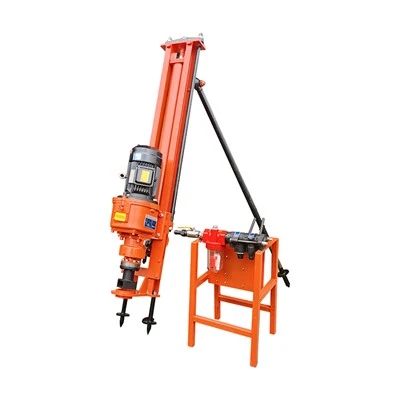
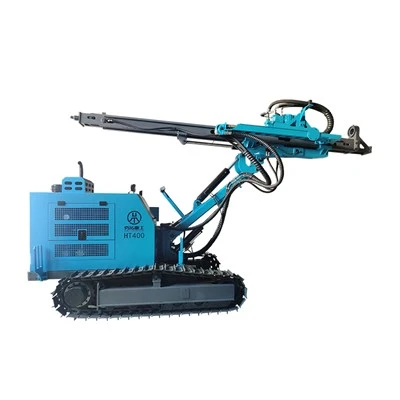
The capacity of an air rock drill to drill through layered rocks is a topic of significant interest in the mining, construction, and geological exploration industries. As a supplier of air rock drills, I have witnessed firsthand the importance of understanding how these tools perform in complex rock formations. In this blog, I will delve into the factors that influence an air rock drill's ability to penetrate layered rocks, the types of air rock drills suitable for such tasks, and real - world applications.


Factors Affecting the Drilling Capacity in Layered Rocks
Rock Properties
Layered rocks can vary greatly in terms of their composition, hardness, and brittleness. Different layers may consist of sedimentary, igneous, or metamorphic rocks, each with distinct physical and mechanical properties. For instance, sedimentary rocks like sandstone and limestone can be relatively soft and porous, while igneous rocks such as granite are much harder and more abrasive. The hardness of the rock is typically measured using the Mohs scale. A harder rock layer will require more energy to drill through, and the drill bit may wear out more quickly. Brittleness also plays a role; brittle rocks tend to fracture more easily under the impact of the drill, which can either aid or hinder the drilling process depending on the layer's thickness and orientation.
Layer Orientation
The orientation of the rock layers relative to the drilling direction is crucial. When the layers are parallel to the drilling path, the drill may encounter less resistance as it can more easily follow the natural planes of weakness within the rock. However, if the layers are perpendicular to the drilling direction, the drill has to break through each layer independently, which can significantly increase the drilling time and energy consumption. In some cases, the drill may even deviate from its intended path if the layers are highly inclined or have varying hardnesses.
Drill Design and Specifications
The design of the air rock drill itself has a major impact on its drilling capacity. Key factors include the power of the drill, the type of drill bit, and the air pressure. A more powerful drill can deliver greater impact energy to break through tough rock layers. The drill bit is the part that directly interacts with the rock, and different bit designs are suitable for different rock types. For example, a tungsten carbide - tipped bit is more suitable for hard rocks, while a diamond - impregnated bit can be used for extremely abrasive rocks. The air pressure supplied to the drill affects the frequency and force of the hammering action. Higher air pressure generally results in more powerful blows, but it also requires a more robust air supply system.
Types of Air Rock Drills for Layered Rocks
Hand Held Rock Drilling Equipment
Hand held rock drilling equipment is a versatile option for drilling in layered rocks, especially in small - scale projects or areas with limited access. These drills are lightweight and easy to maneuver, allowing operators to target specific areas accurately. They are typically powered by compressed air and can be used for a variety of tasks, such as drilling holes for anchor bolts, sampling, or small - scale blasting. However, their power is relatively limited compared to larger drills, so they may be less effective when dealing with thick or extremely hard rock layers.
Mini Pneumatic Drill
Mini pneumatic drill are another option for drilling through layered rocks. These drills are compact and can be used in confined spaces. They are often used in geological exploration, where small - diameter holes are required for sampling and testing. Mini pneumatic drills can be equipped with different types of drill bits to adapt to various rock conditions. Their relatively low power consumption makes them suitable for long - term drilling operations, but they may also take longer to drill through thick layers compared to larger drills.
Pneumatic Air Leg Rock Drill
Pneumatic air leg rock drill are more powerful than hand - held and mini drills. The air leg provides additional support and thrust, allowing the drill to apply more force to the rock. This makes them well - suited for drilling through thick and hard rock layers. They are commonly used in mining and large - scale construction projects, where high - productivity drilling is required. The air leg can also be adjusted to different angles, making it easier to drill in various directions and orientations.
Real - World Applications
Mining Industry
In the mining industry, air rock drills are used to create blast holes in layered rock formations. These holes are filled with explosives to break up the rock for extraction. The ability of the drill to penetrate through different layers of rock efficiently is crucial for the overall productivity of the mining operation. For example, in a gold mine where the ore is embedded in layered quartz and granite rocks, an air rock drill with the right specifications can quickly and accurately create the necessary blast holes, reducing the time and cost of extraction.
Construction Industry
In construction, air rock drills are used for tasks such as foundation work and tunneling. When building a foundation, the drill may need to penetrate through layers of soil, sedimentary rock, and sometimes even hard bedrock. A reliable air rock drill can ensure that the foundation holes are drilled to the required depth and diameter, providing a stable base for the structure. In tunneling projects, the drill is used to create holes for rock bolts and support structures. The drill's capacity to handle layered rocks is essential for maintaining the integrity of the tunnel walls and ensuring the safety of the workers.
Geological Exploration
Geological exploration teams use air rock drills to collect rock samples from different depths and layers. By analyzing these samples, they can gain insights into the geological history and potential mineral resources of an area. An air rock drill that can drill through layered rocks without disturbing the sample quality is highly valuable in this field. For example, in a research project studying the sedimentary layers of a coastal area, a drill that can precisely extract samples from each layer can provide important data on past environmental conditions.
Conclusion
The capacity of an air rock drill to drill through layered rocks depends on a variety of factors, including rock properties, layer orientation, and drill design. As a supplier of air rock drills, I understand the importance of providing high - quality products that can meet the diverse needs of different industries. Whether you are in the mining, construction, or geological exploration field, choosing the right air rock drill is crucial for the success of your project.
If you are interested in learning more about our air rock drills or have specific requirements for drilling through layered rocks, I encourage you to contact us for a detailed discussion. Our team of experts is ready to assist you in selecting the most suitable drill for your application and ensuring that you get the best performance and value for your investment.
References
- Jaeger, J. C., Cook, N. G. W., & Zimmerman, R. W. (2007). Fundamentals of Rock Mechanics. Blackwell Publishing.
- Hudson, J. A., & Harrison, J. P. (2000). Engineering Rock Mechanics: An Introduction to the Principles. Pergamon.
- Salamon, M. D. G. (1996). Rock Mechanics in Mining. Butterworth - Heinemann.