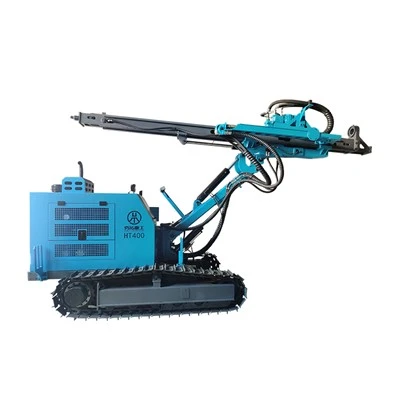
Down-the-hole drilling (DTH) essentially involves a drill hammer at the bottom of a drill column. It relies on three elements to drill: bit load (weight), rotation and air. These active elements combine to effectively break up rock. As the drill column slowly rotates, the hammer is repeatedly pressed into the rock. The striking force is provided by compressed air that drives a piston inside the hammer.
Working principle of submerged rock drilling
The essence of submerged rock drilling is to submerge the impactor into the hole during the drilling process to reduce the energy loss due to the transfer of impact work from the drill rod, thus reducing the effect of hole depth on drilling efficiency. The rock drilling equipment for submerged rock drilling is submerged rock drilling rig, which is a kind of impact rotary drilling rig, and its internal structure is different from the general rock drilling rig, its gas distribution and piston reciprocating mechanism is independent, that is, the front end of the impactor is directly connected with the drill bit, and the back end is connected with the drill rod. When drilling, the impactor dives into the hole, and through the air distribution device (valve), the piston (hammer body) in the impactor makes reciprocating motion, striking the braze tail and making the drill bit impact the rock at the bottom of the hole. The high-speed rotation of the impactor inside the hole is realized by a separate rotating mechanism, i.e., by an electric motor or wind-powered rotating device outside the hole, through the drill rod attached to the back end of the impactor. The rock dust produced during rock drilling is flushed out of the hole by the air-water mixture, which is injected into the impactor through the center of the drilling rod by the dust discharge mechanism, and then enters into the bottom of the hole through the air groove on the barrel of the impactor.
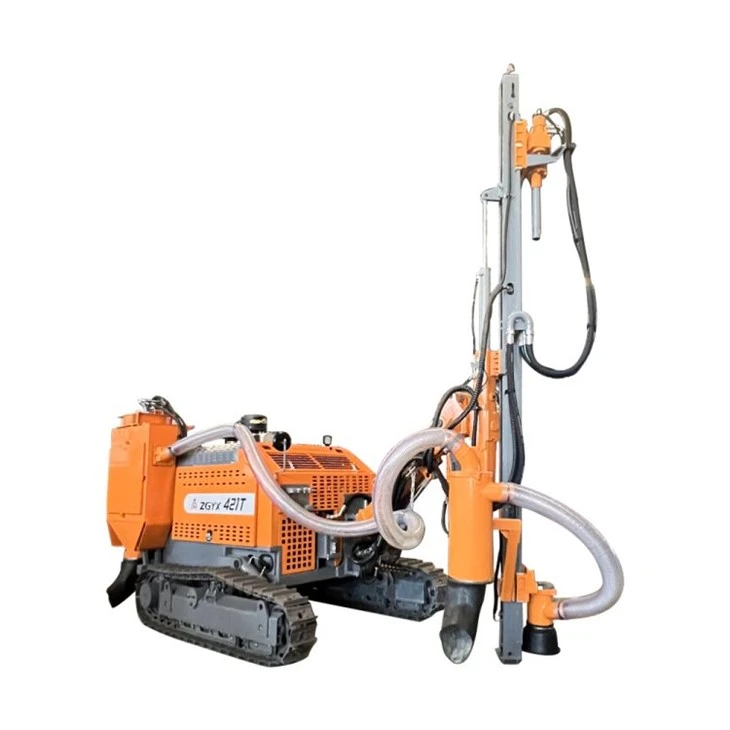
Features of Down Hole Drilling Rig
The slewing power of the Down Hole Drilling Rig is provided by the electric motor through the high-performance reducer, and the propelling power is provided by the oil cylinder. As there is no hydraulic system, the mechanical efficiency is high, the cost is low and the performance is stable.
Due to anti-jam protection, the reducer and motor are not easy to burn out and damage when the down hole drilling tool is jammed.
The machine is light in weight and easy to move; the total weight is less than 500 kilograms, and it can be disassembled into three pieces, which is easy to move and store.
Adopting rolling drag plate, the track is not easy to wear out.
The down hole drilling machine adopts semi-automatic cloud technology to untie the drill pipe, with high working efficiency.
Application of Down Hole Drilling
Drilling rigs for down holes find extensive application in sectors like metallurgy, mining, railways, hydropower, national defense building, dredging, earthmoving, and various other blast hole drilling endeavors. Shanhe Intelligence boasts an extensive array of drilling rigs designed to accommodate a broad spectrum of drilling diameters.
DTH drills play a crucial role in quarrying by creating blast holes, extracting rocks, and molding their surfaces. Their accuracy and effectiveness render them ideal for quarrying activities.
DTH drills find their application in activities like drilling foundations, piling, and securing structures in construction endeavors. These devices are adept at infiltrating tough rock or dense soil, offering a dependable drilling technique.
Drilling rigs for DTH are employed in water well drilling endeavors, particularly in regions characterized by rugged or rocky subterranean environments. The rigs are adept at infiltrating diverse geological structures to reach water bodies.
Geotechnical investigations employ DTH drilling rigs for the gathering of soil and rock specimens. Their crucial function lies in gathering samples to examine underground conditions and assess the terrain's appropriateness for building.
In the realm of oil and gas exploration, DTH rigs serve to bore holes for assessing underground structures and identifying possible hydrocarbon deposits. Their efficacy is especially notable in the context of hard rock structures.
Foundation engineering employs DTH rigs to construct boreholes for examining soil and conducting field tests. These tools aid engineers in grasping the geological prerequisites necessary for creating robust foundations.
Environmental surveillance programs employ DTH rigs to gather samples of soil and rock, aiming to evaluate the impact of different pollutants and contaminants present in the soil.
Summary
DTH rigs play a vital role in effectively drilling through hard rock formations in a variety of industries. Their characteristics make them ideal for demanding drilling applications where accuracy and productivity are critical. We are a supplier of DTH drilling rigs, so please feel free to contact us if you have a need. We accept all OEM orders, just contact us and send me your design. We will offer you reasonable price and make samples for you as soon as possible.