As a key power equipment in the industrial field, the selection process of screw air compressors needs to comprehensively consider multiple factors such as performance, cost, and adaptability. For first-time buyers, facing the dazzling array of models and parameters on the market, it is crucial to ask accurate questions to match their own needs. The following is a systematic questioning guide to help you start with the core issues and avoid pitfalls.
Ⅰ. Basic parameters: What are my actual needs?
1. "What type of screw air compressor do I need?"
- Fixed or mobile? Oil-injected or oil-free? Oil-injected machines are low-cost but may pollute compressed air, while oil-free machines are suitable for industries with high cleanliness requirements such as food and medicine.
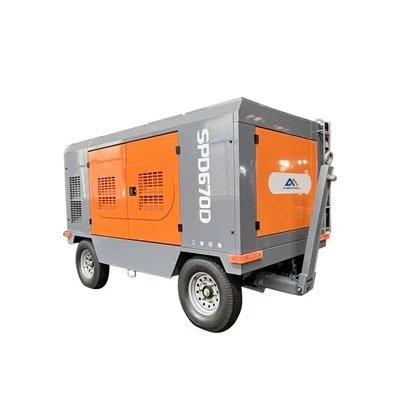
- For example: an automobile repair workshop can choose an oil-injected mobile air compressor, while an electronic chip factory may need an oil-free silent model.
2. "What is the exhaust volume (m³/min) and pressure (Bar) of a screw air compressor do I need?"
- The exhaust volume needs to cover the peak demand of the gas-using equipment, and the pressure needs to be slightly higher than the equipment requirements (it is recommended to reserve a 10% margin).
- Counter-question scenario: If the production line starts 5 pneumatic tools at the same time, each requiring 1m³/min, the total exhaust volume needs to be ≥5.5m³/min.
Ⅱ. Power and energy efficiency: How to balance performance and cost?
3. "Is the power source an electric motor or a diesel engine?"
- When the factory power supply is stable, choose an electric motor (pay attention to the adaptability of three-phase electricity); diesel-powered models are required for field operations or frequent power outages.
4. "What is the energy efficiency level? Does it support variable frequency energy saving?"
- A first-level energy efficiency machine saves 15%-20% more electricity than a third-level machine. Variable frequency technology can dynamically adjust the speed to avoid no-load energy consumption.
- Do the math: A 22kW variable frequency machine can save more than 20,000 yuan in electricity bills per year (calculated at 8 hours/day and 0.8 yuan/kWh).
Ⅲ. Cost of use: Where are the hidden expenses hidden?
5. "What are the maintenance cycles and consumables costs?"
- The frequency of filter replacement and the amount of lubricant used directly affect long-term costs. For example, the price of a certain brand of air filter is 300 yuan/piece, which needs to be replaced twice a year, and the lubricant consumption is 0.5L/day.
6. "What does after-sales service include?"
- Is there free on-site repair during the warranty period? Is remote fault diagnosis provided? How long is the emergency response time?
- Case: A manufacturer promised to arrive at the site within 24 hours, saving users more than 50,000 yuan in downtime losses each year.
Ⅳ. Scenario adaptation: details determine success or failure
7. "Does the noise level meet environmental protection requirements?"
- Hospitals, laboratories and other scenarios require silent models of ≤60 decibels; ordinary workshops can accept less than 75 decibels.
8. "Are the equipment size and installation conditions limited?"
- Check the height of the factory door and ventilation conditions to avoid the embarrassment of "affordable but not installable". For example, a user paid an additional 5,000 yuan for disassembly because he did not measure the door width.
---
Ⅴ. Advanced questions: needs that may be ignored in the future
9. "Does it support intelligent management?"
- The IoT function can monitor air pressure and temperature in real time, and warn of faults through the APP, which is especially suitable for unmanned workshops.
10. "Is there an expansion interface to cope with capacity increase?"
- Reserve a parallel interface for multiple units to avoid repeated purchases during later expansion.
Summary: Logical chain of questions
From demand analysis (type, parameters) → cost control (energy efficiency, maintenance) → scenario adaptation (noise, installation) → forward planning (intelligence, scalability), progressive questions can accurately lock in the optimal model. Finally, remember: require on-site testing to observe the actual performance of start-up time, pressure stability, etc. The parameters on the data sheet may not represent the actual working conditions.
Remember: buying the right equipment is the first step to saving money. A rigorously demonstrated purchasing decision may save you hundreds of thousands of yuan in comprehensive costs in the next ten years.
If you are going to buy a screw air compressor right now, please ask me these questions.