How to match the drilling system, connection, diameter, face design, and carbide profile before you order
| Quick answer Start with the drilling system. A DTH bit’s shank must match the hammer chuck, bit-retaining interface, and specified hammer model. A top hammer bit must match the rod thread. Then confirm the required hole diameter, rock condition, face design, skirt design, button profile, and flushing arrangement. T38, T45, and T51 components are different systems and are not directly interchangeable. |
Why Two Similar Button Bits Can Deliver Very Different Results
At first glance, many rock drill bits look alike: a steel body, a ring of tungsten carbide buttons, and flushing holes. The differences that control performance are less obvious - the connection, steel and heat treatment, carbide grade, face geometry, skirt design, and manufacturing tolerance.
The useful purchasing metric is not simply the price per bit. It is the total cost per drilled meter, including the bit, regrinding, tool-change time, lost production, and any damage caused by a mismatched or prematurely failed component.
| Cost-per-meter principle Cost per drilled meter = (bit cost + regrinding + tool-change downtime + related drill-string losses) / meters drilled. A higher purchase price can still be economical when the bit produces more meters, maintains gauge diameter, and reduces interruptions. |
Before requesting a quotation, answer these questions:
- Is the rig using a DTH hammer or a top hammer rock drill?
- What exact hammer shank or rod thread is installed?
- What finished hole diameter and hole depth are required?
- Is the formation competent, abrasive, fractured, weathered, or squeezing?
1. DTH Button Bit vs Top Hammer Button Bit
The most important distinction is where the impact mechanism is located and how the bit connects to the drill string.
| Selection point | DTH button bit | Top hammer button bit |
|---|---|---|
| Impact mechanism | The pneumatic hammer operates down the hole, directly behind the bit. | The rock drill is mounted on the feed at the surface or on the drill rig. Impact energy travels through the drill string. |
| Connection | A splined shank locks into a specific DTH hammer chuck. | A threaded connection screws onto a compatible rod, such as R25, R28, R32, T38, T45, T51, or a manufacturer-specific heavy-duty thread. |
| What must match | Hammer make, hammer series, shank profile, bit diameter, and air/flushing requirements. | Bit thread, rod thread, coupling, shank adapter, diameter, and rig power. |
| Common strengths | Often selected for deeper holes, larger diameters, and stable energy delivery at the bottom of the hole. | Common in tunneling, drifting, bench drilling, bolting, and many shallow-to-medium hole applications. Modern systems also cover large hole ranges. |
| Can they interchange? | No. A DTH bit cannot be installed on a threaded top hammer rod. | No. A threaded top hammer bit cannot lock into a DTH hammer chuck. |
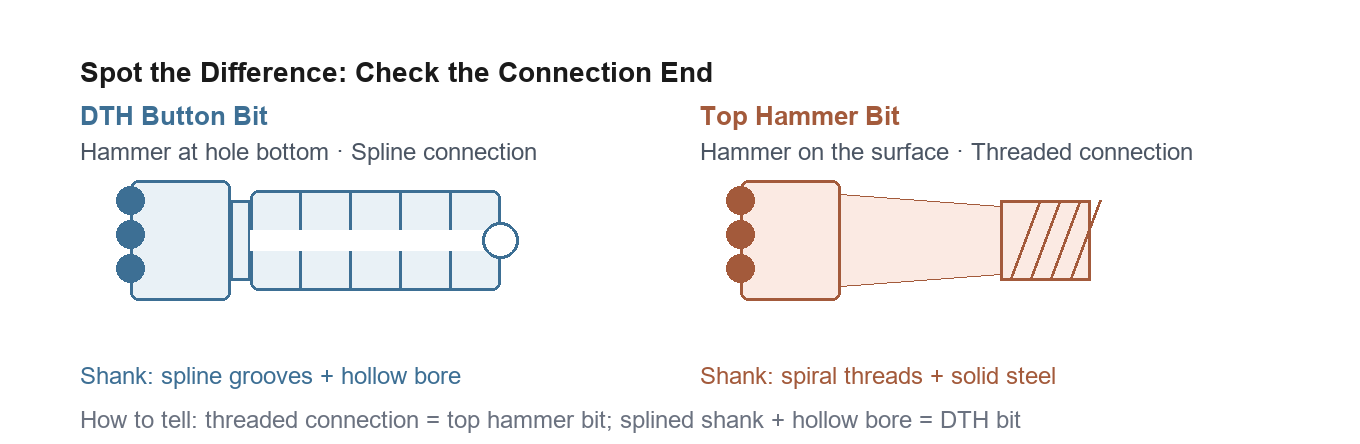
Figure 1. The connection end is the fastest first check: splined shank for DTH, threaded end for top hammer.
| Fast identification check Look at the end opposite the carbide buttons. Longitudinal splines and a central air bore normally indicate a DTH bit. A machined helical thread indicates a top hammer bit. Still confirm the stamped code or drawing before ordering, because visually similar shanks and threads may use different dimensions. |
2. Retrac vs Regular Skirt: What the Design Actually Means
Retrac describes a top hammer bit skirt design, not the thread connection and not the face shape. Manufacturers commonly offer regular and retrac skirt families, but the exact geometry is not universal.
A retrac-style skirt may use an extended skirt, relief sections, shoulders, ribs, or guide features intended to support hole guidance and make withdrawal easier in broken, fractured, or squeezing ground. Some suppliers also use terms such as short retrac, standard retrac, or guide retrac for different product families.
A regular skirt normally has a simpler transition behind the bit head and is widely used in stable formations. It can be lighter and economical when difficult withdrawal or additional guidance is not the main concern.
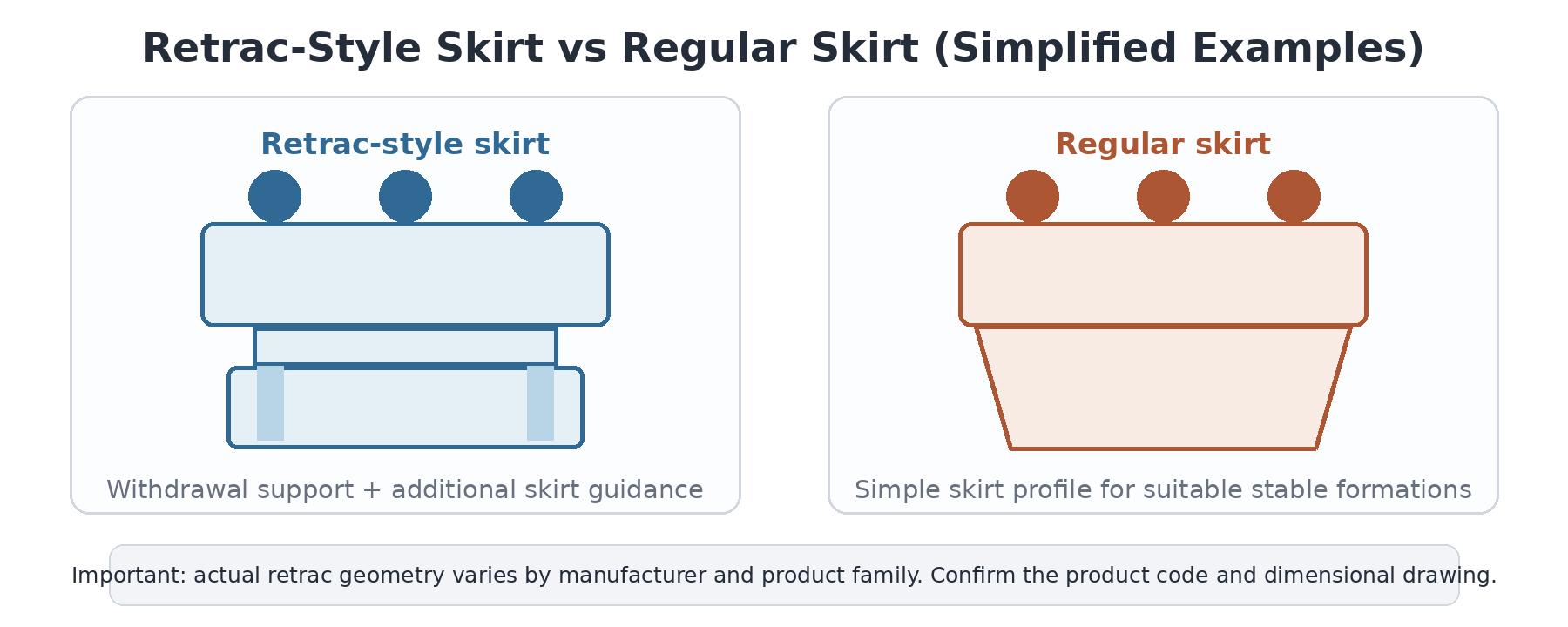
Figure 2. Simplified skirt comparison. Do not identify a retrac bit from one fixed groove dimension alone.
| How to verify a retrac bit Use the manufacturer product code, catalogue description, and dimensional drawing. A caliper can help compare the head and skirt, but a fixed rule such as "the body must be 2-5 mm smaller" is not reliable across brands and bit families. |
When a retrac design is worth considering
Fractured or blocky rock where the bit is more difficult to withdraw.
Weathered or squeezing formations that may close around the bit.
Applications where additional skirt guidance can help control hole deviation.
Drilling conditions where a stuck bit could risk rods, couplings, or production time.
Final selection should still consider rig power, hole diameter, rock abrasiveness, flushing, and the manufacturer's application guidance.
3. Thread Size and Button Bit Diameter
For top hammer drilling, both the thread and the diameter must match the drill string and the hole plan. The thread code identifies the connection family; it does not by itself define one fixed bit diameter.
| Thread family | Common catalogue examples* | Typical use range |
|---|---|---|
| R25 | 33-51 mm | Light drilling, bolting, handheld and small-hole applications |
| R28 | 37-48 mm | Small drifters and light development drilling |
| R32 | 41-76 mm | Drifting, tunneling, bolting, and small-to-medium top hammer rigs |
| T38 | 64-102 mm | Bench, tunneling, and production drilling |
| T45 | 66-127 mm | Medium-to-large top hammer drilling and bench work |
| T51 | approximately 76–140 mm for common flat and power-face examples; selected dome or specialty designs may reach 152 mm. | Large-hole production, bench drilling, and heavy-duty applications |
| GT60 | Approximately 92-152 mm and larger, depending on system | Verify compatibility with the matching GT60 rods, couplings, and shank adapter. |
| TW60 | Epiroc-specific heavy-duty thread system | Verify compatibility with the matching TW60 drill-string components. |
*These are representative catalogue examples, not universal limits. Available diameters vary by manufacturer, face design, skirt design, and product family. Dome bits, reaming bits, and hole openers may extend beyond the standard button-bit range.Manufacturer-specific heavy-duty systems must not be assumed interchangeable, even when their nominal sizes appear similar.
| Compatibility warning T38, T45, and T51 are different connection sizes. A rig may be reconfigured to use another drill-string family by changing the matching shank adapter, rods, couplings, and bit, but the components are not directly interchangeable within one assembled string. |
How to confirm the thread
- Read the code stamped on the existing bit, rod, coupling, or shank adapter.
- Compare the component with the rig or rock-drill parts manual.
- Measure only as a secondary check; thread form, pitch, shoulder, and drive geometry also matter.
- Send clear photos and dimensions to the supplier when the marking is worn or missing.
How to choose the diameter
Start with the required finished hole size and the complete drilling plan. A smaller diameter within a compatible system may reduce torque demand and increase penetration, but it cannot replace the specified final hole diameter. Also consider gauge wear, required clearance, casing or anchor dimensions, blasting design, and allowable hole deviation.
4. Face Design and Carbide Button Profile
After the connection and diameter are correct, face geometry and carbide profile influence penetration, stability, flushing, and wear. Terminology varies by manufacturer, so compare the actual button map and face drawing rather than relying on a product name alone.
| Design choice | General purpose | Selection note | Selection note |
|---|---|---|---|
| Flat or power face | Broad contact pattern and common use in many rock conditions. | Check button count, gauge angle, and flushing layout for the specific formation. | Check button count, gauge angle, and flushing layout for the specific formation. |
| Drop-center / concave face | Can provide centering and stable tracking in suitable conditions. | Not automatically best for every fractured formation; verify with the rig and geology. | Not automatically best for every fractured formation; verify with the rig and geology. |
| Convex / dome-type face | Used in selected hard-rock or specialty applications. | Often appears in larger or specialized product families. | Often appears in larger or specialized product families. |
| Spherical buttons | Rounded profile with robust edges and broad use. | Often selected where toughness and wear resistance are priorities. | Often selected where toughness and wear resistance are priorities. |
| Ballistic / semi-ballistic buttons | More pointed profile intended to concentrate contact. | Can support penetration in suitable rock, but may be more sensitive to impact and geology. | Can support penetration in suitable rock, but may be more sensitive to impact and geology. |
| Conical or proprietary profiles | Manufacturer-specific balance of penetration and wear. | Use the supplier's carbide and application data rather than treating all conical profiles as identical. | Use the supplier's carbide and application data rather than treating all conical profiles as identical. |
| Important terminology correction "Conical" and "rounded" are not the same description. Common button families include spherical, ballistic or semi-ballistic, conical, and manufacturer-specific profiles. The best option depends on hardness, abrasiveness, fracturing, drilling parameters, and carbide design. | Important terminology correction "Conical" and "rounded" are not the same description. Common button families include spherical, ballistic or semi-ballistic, conical, and manufacturer-specific profiles. The best option depends on hardness, abrasiveness, fracturing, drilling parameters, and carbide design. | Important terminology correction "Conical" and "rounded" are not the same description. Common button families include spherical, ballistic or semi-ballistic, conical, and manufacturer-specific profiles. The best option depends on hardness, abrasiveness, fracturing, drilling parameters, and carbide design. |
5. Guide Button Bits vs Casing-System Pilot Bits
These terms are sometimes mixed together, but they describe different functions.
| Tool | Primary function | Compatibility check |
|---|---|---|
| Top hammer guide button bit | Uses an extended guide skirt or guide features to support a straighter, more stable hole in suitable applications. | Must match the top hammer thread, rod system, diameter, and rig power. |
| Casing-system pilot bit | Drills ahead as part of an overburden or casing-advance system so casing can be installed through unstable material. | Must match the specific casing system, reamer or ring bit, casing shoe, drive components, and required casing size. |
| Casing shoe | Protects or advances the lower end of the casing, depending on the system. | Match the casing OD and ID, connection, casing shoe design, pilot or ring-bit interface, reaming system, and ground conditions. |
For water wells, anchors, piles, and other work through sand, gravel, weathered layers, or collapsing overburden, ask for the complete casing-system specification. A top hammer guide bit alone is not automatically a casing pilot bit.
6. Five Quality Checkpoints Before You Buy
Once the specification is correct, manufacturing quality determines whether the bit can maintain diameter, transfer impact energy, retain the carbide, and deliver consistent drilling performance.
1. Carbide grade and button map
Ask for the carbide profile, button diameter, gauge and center-button arrangement, and intended rock range. The carbide must balance hardness with toughness; the hardest grade is not automatically the best in every formation.
2. Body steel and heat treatment
The bit body should use suitable alloy steel and a controlled heat-treatment process. Excessively soft steel can wear quickly, while an improper hardness profile can increase fatigue or cracking risk.
3. Flushing holes and grooves
Flushing must remove cuttings without weakening the head. Poorly positioned or undersized passages can increase recutting, heat, and wear. Compare the flushing layout with the available air or water flow.
4. Thread and shank machining
Top hammer threads and DTH shanks require accurate machining and clean contact surfaces. Check fit, shoulder contact, spline condition, and visible defects before use.
5. Batch consistency and traceability
Request the inspection items relevant to the order, such as dimensions, hardness, material records, carbide specification, product marking, and batch identification. Consistency matters as much as one good sample.
7. Information to Send for Accurate Bit Selection
A complete inquiry reduces back-and-forth and prevents a quotation for the wrong connection. Provide as many of the following details as possible:
Rig model and rock-drill model, or the DTH hammer make and series.
Current rod thread or DTH shank code, with clear photos of the connection end.
Required finished hole diameter and expected hole depth.
Application: quarry, underground mine, tunneling, bench drilling, bolting, water well, foundation, or another use.
Rock condition: hardness, abrasiveness, fracture level, weathering, water, or squeezing ground.
Preferred face design, skirt design, button profile, and flushing arrangement, if already specified.
Quantity, marking or branding requirements, packaging, destination, and target delivery schedule.
| Minimum information for a first match Rig or hammer model + connection code + required hole diameter. Adding rock condition and application allows a much better recommendation. |
8. Why Drilling Contractors Choose D Miningwell
D Miningwell supplies rock drilling tools for mining, quarrying, tunneling, construction, water-well, and related drilling applications. The available range includes DTH bits and hammers, threaded top hammer bits, drill rods, shank adapters, couplings, and selected casing tools.
Complete drill-string support. Customers can discuss the bit together with the hammer or rock drill, rods, couplings, shank adapters, and casing requirements instead of treating each component in isolation.
Specification-based matching. Recommendations are based on the actual connection, diameter, rig, application, and ground condition. Photos and drawings can be used when markings are unclear.
OEM and order flexibility. Button profile, face, skirt, marking, branding, and packaging options can be discussed according to the model, quantity, and manufacturing feasibility.
Inspection and documentation. Dimensional checks, product identification, and other inspection or documentation requirements can be confirmed before production and shipment.
Related Product Categories
Threaded button bits: R32, T38, T45, T51, GT60(https://www.dminingwell.cn/drill-tools/drilling-bits/)
DTH bits and water-well drilling tools
https://www.dminingwell.cn/drill-tools/
)
Frequently Asked Questions
What is the difference between DTH and top hammer button bits?
A DTH bit has a splined shank for a specific down-the-hole hammer. A top hammer bit has a threaded connection for a compatible drill rod. They are not interchangeable.
What is a retrac button bit?
It is a top hammer bit with a retrac-style skirt intended to support guidance and withdrawal. Exact geometry varies by manufacturer.
Does a retrac bit always have a 2-5 mm undercut?
No. A single fixed measurement is not a universal identification rule. Confirm the catalogue description, product code, and dimensional drawing.
Are T38, T45, and T51 bits interchangeable?
No. They are different thread systems. A rig may be converted to another system only by changing the matching components, such as the shank adapter, rods, couplings, and bit.
How do I know which thread size I need?
Check the code on the current bit, rod, coupling, or shank adapter against the rig parts information. If it is missing, send photos and measured dimensions.
What diameter button bit should I use?
Use the diameter required by the drilling, blasting, anchoring, casing, or construction plan. Then confirm that the chosen diameter is available and suitable for the connection and rig power.
Which button shape is best for hard rock?
There is no universal answer. Button profile must be selected with rock abrasiveness, fracturing, impact settings, flushing, and carbide grade.
What details are needed for an OEM quotation?
Provide the connection, diameter, face, skirt, button map or drawing, quantity, marking, packaging, and application.
What is the MOQ?
MOQ depends on the model, connection, diameter, and customization. Trial quantities may be available for selected products.
| Need help matching a button bit? Send the rig or hammer model, the connection code, the required hole diameter, and a description of the rock. D Miningwell can review the information and recommend a compatible DTH or top hammer configuration. |
Technical References
Manufacturer resources used to verify terminology and representative ranges are listed below. The applicable supplier drawing remains the final dimensional reference.
Sandvik - Top hammer drill bits and button/skirt terminology
Epiroc - Tophammer product catalogue
Sandvik - Top hammer rock drilling tools catalogue
Epiroc - Casing advancer overview for unstable overburden
Need help matching a button bit? Send the rig or hammer model, connection code, required hole diameter, and rock condition. D Miningwell can review the information and recommend a compatible DTH or top hammer configuration.
View drilling bits or contact us for specification-based selection support.