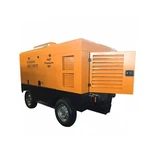
Atlas Copco screw air compressors play a core role in ensuring stable air supply in industrial production. Failure to start is the most common on-site fault and directly affects production. This article provides a full-process solution from simple to complex, from quick inspection to in-depth maintenance, covering four major dimensions: electrical, control, mechanical, and protection systems, helping you quickly locate faults, resume operation, and reduce downtime losses.

Fault Overview: First Judge 3 Typical Phenomena
After pressing the start button, the equipment usually presents 3 types of states, corresponding to different fault directions:
 No response at all: No panel display, no indicator lights, no sound → Prioritize checking the power supply and emergency stop circuit
 Buzzing/engagement sound but no rotation → Prioritize checking voltage, phase loss, contactor, and motor load
 Tripping/alarming immediately after startup → Prioritize checking overload, main unit seizure, and protection device activation
Follow the principle of from outside to inside, from electrical to mechanical, from simple to complex for troubleshooting to avoid blind disassembly.
Step 1: Power Supply & Electrical Circuit (80% of Faults Originate Here)
1. External Power Supply Check
- Check if the main switch, circuit breaker, and fuse are closed and intact
- Measure three-phase voltage with a multimeter: normally ±10% of the rated value; startup is impossible if below 90%
- Troubleshoot phase loss, phase sequence error, and neutral wire reverse connection; Atlas Copco models will directly lock the unit due to phase sequence protection
- Check if cable joints and terminals are loose, ablated, or oxidized
2. Control Power Supply & Emergency Stop Circuit
- Check if panels such as Elektronikon are lit; if not, first check the control transformer and fuse
- Confirm that the emergency stop button, door switch, and safety cover switch have been reset
- Check if the control lines are loose, short-circuited, or broken
3. Contactors & Relays
- Listen for contactor engagement when starting; if not engaging, check the coil, auxiliary contacts, and start button
- Ablated or stuck contacts will cause failure to switch on/off normally and need to be polished or replaced
- After the thermal overload relay trips, it must be cooled and reset before restarting
Step 2: Control System & Protection Logic (Prioritize Panel Alarms)
Atlas Copco air compressors are equipped with a complete protection logic, and the startup conditions must be met to operate:
Clear historical alarms: The unit will lock if alarms such as high temperature, high pressure, low oil level, motor overload, and filter clogging are not reset
Check start-stop conditions: Excessively high system pressure, wrong remote/local mode, and unrelieved timed shutdown
Controller parameters: Check if parameters have been incorrectly modified and if communication is interrupted
Sensor status: Faults in temperature, pressure, and oil level sensors will block the startup signal
Quick handling: First performfault reset on the panel; if it still fails to start, check the hardware.
Step 3: Mechanical & Main Unit System (Forbidden to Force Startup)
1. Main Unit Seizure/Difficult Cranking (Most Dangerous)
Cut off the power supply and manually crank the coupling or flywheel
If it cannot be cranked, gets stuck, or feels heavy → Main unit seizure: lack of oil, carbon deposition, bearing damage, or foreign objects entering
Forbidden to repeatedly attempt inching, which will burn the motor and damage the main unit
2. Motor Faults
Measure motor insulation and three-phase resistance to judge winding short circuit, open circuit, and grounding
Motor bearing damage and stator-rotor rubbing will cause excessive startup resistance
3. Transmission System
Belt-driven models: broken belt, excessive tightness, or slipping
Direct-connected models: damaged coupling, misalignment, or broken elastomer
Step 4: Oil Circuit & Auxiliary System (Easily Overlooked)
Lorem ipsum dolor sit amet consectetur adipisicing elit.
Too low lubricating oil level and severely deteriorated oil quality trigger protection due to insufficient lubrication of the main unit
Difficult startup under pressure if the oil-gas tank pressure is not relieved
Stuck temperature control valve and oil cut-off valve affect startup conditions
5-Minute Quick Troubleshooting Process (On-Site First Choice)
If it is still ineffective, enter in-depth maintenance.
Common Fault Causes & Solution Comparison Table
|
Fault Phenomenon |
Core Cause |
Processing Method |
|---|---|---|
|
No panel response |
No control power, damaged transformer/fuse |
Check power supply, replace fuse/transformer |
|
No startup action |
Emergency stop, door switch, or contactor damage |
Reset, check lines, replace contactor |
|
Buzzing but not rotating |
Phase loss, low voltage, motor jamming |
Measure electricity, crank the unit, maintain motor |
|
Tripping immediately after startup |
Overload, main unit seizure, short circuit |
Check machinery, insulation, protection values |
|
Alarm and unit lock |
High temperature/high pressure/low oil level |
Eliminate alarms, check sensors |
Prevention Suggestions: Reduce Failure to Start Faults
Regularly tighten electrical connections to prevent loose heating
Replace lubricating oil and three filters on time to avoid carbon deposition and seizure of the main unit
Maintain stable power supply and install voltage stabilizers and phase sequence protection
Regularly test safety components such as emergency stop and door switches
Do a good job in dust and moisture prevention to extend the service life of electrical components

Conclusion
For Atlas Copco screw air compressors that fail to start, the most efficient approach is electrical first, mechanical second; protection first, mechanical second. Most problems can be quickly solved by checking the power supply, emergency stop, alarms, and cranking. In case of main unit seizure or motor insulation faults, it is recommended to contact professional after-sales service to avoid expanding damage.